
THE SPANISH TOURIST OFFICE LEADS PANEL DISCUSSION ON ENHANCING ACCESSIBLE TOURISM AT WORLD TRAVEL MARKET
‘Spain For All’ ambassador Ade Adepitan outlines his desire to make Spain the best destination for travellers with disabilities and accessibility requirements
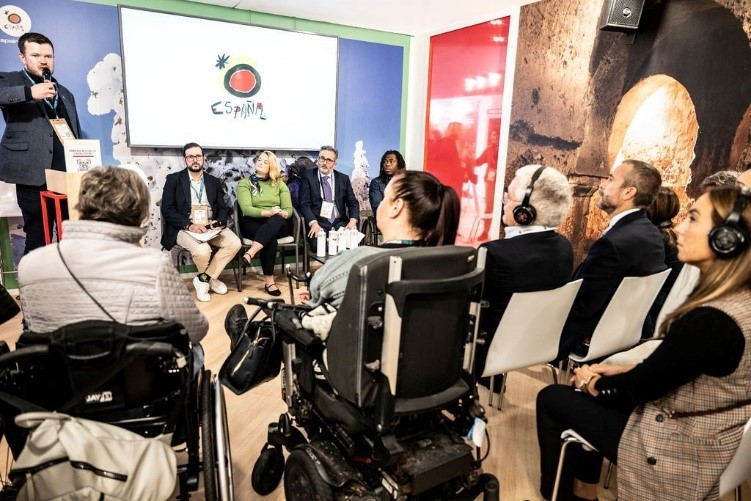
London, November 2024: At the World Travel Market 2024, the Spanish Tourist Office UK placed tourism accessibility at the forefront, hosting a panel dedicated to improving accessibility within the tourism sector. The session featured several advisory members of the ‘Spain For All’ committee including Angus Drummond (Moderator), CEO of Limitless Travel & Accessibility Consultant, Miguel Carrasco, Director of the Spanish non-profit organisation Impulsa Igualdad and Tur4All, Marina Snellenberg, Accessibility Manager at TUI and Pedro Medina, Deputy Director of the Spanish Tourist Office. The panel joined by TV presenter and access-needs ambassador, Ade Adepitan, to discuss ‘Spain For All’, a campaign striving to improve the experience for access-needs travellers while visiting the destination.
The panel aimed to explore strategies and solutions for enhancing accessibility across the tourism industry. Drummond, recognised the advancements that the industry has made in allowing all people to enjoy the most enriching of travel experiences, however noted that there is still a long way to go and further challenges to overcome.
'Spain For All' ambassador Ade Adepitan shared his reasons for becoming the ‘Spain For All’ ambassador and his love for Spain revealing that he first travelled to Spain in the mid-nineties as part of a basketball tour to the country. The ambassador spoke of his time in Zaragoza and explained how he felt Spain was further ahead than other destinations in its accessibility journey saying that he now travels to the country once or twice a year: “it’s like my second home and they have created a blueprint in accessible tourism”.
Adepitan was inspired as a youngster by physiotherapists who got him into basketball and encouraged him to help people, help people. “Travel is one of the greatest powers we have as the human race and for so long, for people with disabilities, it has been closed off. It’s heart-breaking that as a kid I felt I could not enjoy the same travel experiences as other more able-bodied people. Travel has enriched my life and it’s only right that I encourage other disabled needs people to travel. My message to all disabled people, we see you and we want to be the leaders for all the destinations to provide those experiences.”
Adepitan said “when the world becomes fully accessible, people will look back at Spain’s campaign and see this was where the seeds were planted,” adding: “This is what’s going to transform the tourism industry, not just in Spain but all over the world.”
Marina Snellenberg from TUI highlighted that it makes commercial sense for travel providers to cater for customers with access needs. Snellenberg explained that “the industry has focused on the moral argument of ‘it’s the right thing to do’, however we at TUI have begun to think about the commercial aspect of catering for people with access needs. Those with access needs spend more, stay longer, and generate significant commercial revenue for the business.” Snellenberg reported that TUI has made big strides in providing for their loyal customer base, some of which have been life-long customers and, as they age, encounter more difficulties when it comes to travelling abroad. Marina also revealed that 40% of all TUI customers choose Spain and that the large majority of their customers with access needs also choose to travel to Spain.
Also present on the panel was Miguel Carrasco, Director of Impulsa Igualdad and Tur4All, a Spanish organisation with over a quarter century of experience in promoting equality and accessibility throughout Spain. Carrasco explained that Impulsa Igualdad has ongoing projects to develop accessibility to destinations within Spain such as in the Valencian Community. Carrasco and Adepitan agreed that Spain’s leadership in destination accessibility began with the Barcelona 1992 Paralympic Games. Carrasco stated: “The city and the country were a spotlight for the world and resulted in Spain surging forward in catering to accessibility needs,” and added that “we need opportunities for self-service for the customer without underestimating the need for accessible travel agents.”
Pedro Medina from the Spanish Tourist Office discussed how through this campaign, the committee has been able to develop the Acessibility Findings Reports. Medina said: “Across three thought-provoking sessions, industry experts, accessibility consultants, and those with lived experiences of disability, spoke on what accessible travel means in 2024. From these sessions that took place between April and June 2024, the Spanish Tourist Office has created this Accessibility Findings Report to underline some of the key challenges and discussion points around accessible travel and carve a roadmap towards a more inclusive travel sector”.
The five pillars of the report include:
- Defining Accessibility and Ensuring Inclusivity
It’s important not to default to wheelchair users when talking about accessibility.
- Closing the Information Gap
There is an information gap on accessible travel for both consumers and businesses.
- Collaboration and Consultation
Accessible travel is a complex topic, and destinations and organisations should not feel they need to adapt alone. Collaboration is key.
- Data
Accessibility adaptations should be data-driven, supported by insights from those with lived experiences of disability, and with integrated feedback loops.
- Adapting the Customer Journey
The entire customer journey should be adapted to accommodate for consumers with accessibility needs from the research and booking process all the way through to end-of-service.
Medina also made it clear that the final area to underline is that this process will require collaboration with industry members. “Businesses and consumers should not feel isolated”, he declared.
The floor was then given to ambassador Ade Adepitan to explain his vision moving forward. “First of all, we will all experience disability at some point in our lives so, somewhat prematurely, welcome to the club!” You can’t build the world for us, without us. My advice to any tourism board or company when you’re thinking about disability is to make sure you include people with different levels of disability because the experience is not homogenous. All people have different experiences. We shouldn’t worry about making mistakes and we shouldn’t be held back by the fear of failure.”
Next steps of the ‘Spain For All’ campaign
The Spanish Tourist Office (UK) announced plans to recruit new advisory members in 2025, with activations scheduled to take place in both the UK and Spain. Medina said: “We need to overcome challenges, we would like to include more voices.”
Manuel Butler, Director of the Spanish Tourism Office in the UK, stated, “At the Spanish Tourism Office, our mission goes beyond promoting destinations through marketing campaigns. We are committed to breaking down barriers in travel, ensuring that everyone has the opportunity to experience Spain's beauty, culture, and diversity. There is still much work to be done, but we are dedicated to making this vision a reality.”
To support or endorse this campaign on social media, please find assets here #SpainForAll.
For more details on this campaign, please see here.
For more information on Spain as a tourism destination, please visit www.spain.info
@Spain_inUK / Spain on Facebook
If you would like to be involved with Spain’s advisory panel on accessibility, please contact Spain@wearelotus.co.uk